Using an AI agent? Feed it this article.
Paste the link into Claude, ChatGPT, or any reasoning agent for a full breakdown of the pattern language methodology and system architecture.
The Premise
Every astronaut describes experiencing the Overview Effect. The moment when Earth, seen from space, dissolves borders and reveals our interconnected fate. What if space architecture could embed that consciousness shift into the built environment itself?
That question drove everything that followed.
Space architecture’s complexity exceeds individual human capacity. A single habitat design must integrate life support thermodynamics, radiation shielding, structural mechanics under variable gravity, human psychology in confined environments, agricultural systems, waste processing, power generation, and dozens of other interdependent domains — all simultaneously. Current tools offer no systematic way to integrate this vast technical knowledge into design workflows. CAD tools draw geometry. Parametric tools adjust parameters. Neither encodes the why behind design decisions.
In 1977, Christopher Alexander published A Pattern Language — 253 patterns encoding centuries of building wisdom into a reusable, interconnected network. Each pattern captured a recurring design problem and its proven solution, expressed in language that was simultaneously poetic and technical. The book transformed terrestrial architecture by making expert knowledge accessible and composable.
The question we asked: Could AI agents extend Alexander’s methodology to extraterrestrial environments — where no one has built anything yet, but where the research already exists in hundreds of scattered technical documents?
Nova Architecture is the answer. An AI-powered design operating system built upon the pattern language methodology. Not a product that generates space stations on command — but a framework where human designers and AI agents collaborate through structured knowledge, iterating toward solutions that are grounded in research evidence and guided by a philosophical vision for what space architecture should be.
The Philosophical Foundation
Before writing a single line of code or extracting a single knowledge snippet, we established four philosophical pillars. This is the decision that separates Nova Architecture from any other generative design exercise. The pillars are not categories. They are the DNA of the entire system — present in every pattern, every agent prompt, every visual output.
Pillar 1
Salutogenesis + Fortigenesis
Design for human flourishing, not mere survival. Spaces that expand consciousness, support psychological wellbeing, and create antifragility. Not minimum viable life support — maximum human development. Spatial hierarchy creating psychological comfort. Sensory diversity preventing monotony. Beautiful, dignity-affirming environments where people grow rather than simply endure.
Pillar 2
Earth as Garden → Galactic Cultivation
Regenerative cultivation over extraction. Closed-loop resource flows. Biomimetic intelligence. Generational thinking. Architecture as systems synthesis — creating symbiotic relationships and alchemical transformation rather than mining and depletion. Gardens, not mines. Every habitat is an ecosystem.
Pillar 3
Energetic Abundance
Kardashev-scale post-scarcity thinking. Design from solar income abundance rather than fossil fuel scarcity mindsets. Space offers effectively infinite energy through fusion futures and solar collection at scale. The architecture optimizes for performance over constraint — generous spatial volumes, rich material palettes, power-positive systems. Abundance as a design principle, not a luxury.
Pillar 4
Technē Technosymbiosis
Technology as craft wisdom in symbiotic relationship with human capability. Transparent, understandable systems. Graceful degradation, not brittle optimization. Human judgment remains primary. Technology amplifies rather than replaces. Tools that empower human agency — which is, not coincidentally, the same philosophy behind how we build AI systems at BioSync Labs.
These pillars are not decorative. They are embedded into the AI agent prompts, the pattern synthesis workflow, and the image generation standards. When the system produces a design, it is not optimizing for structural efficiency alone — it is optimizing for human flourishing within structural constraints. That distinction changes everything about the output.
The Knowledge Architecture
With the philosophical foundation set, the next challenge was structural: how do you take 600+ pages of scattered technical research and make it usable by AI agents in real-time design workflows?
The answer is three layers of progressive refinement, each serving a different purpose in the system.
The patterns are organized across four scales — from orbital society down to the controls on a wall panel:
Following Alexander’s methodology, patterns form networks, not hierarchies. Each pattern completes larger patterns above it and is completed by smaller patterns below it. A habitat volume allocation pattern (Settlements) connects to psychological wellbeing patterns (Interfaces) and life support patterns (Metabolism). The network is the intelligence — not any single pattern in isolation.
The Agent System
Knowledge alone is not enough. The system needs intelligence that can reason about patterns, apply them to specific design problems, and generate concrete architectural output. That intelligence comes from three specialist AI agents, each with deep domain focus.
Massing Specialist
Spatial organization, volumes, circulation
Thinks in zones, relationships, and hierarchy. Works with basic geometric primitives. Draws primarily from Settlements and Constellations patterns. This agent decides the overall form — where zones go, how volumes relate, what the spatial experience feels like at the macro scale.
Technical Specialist
Systems integration, structural logic, life support
Thinks in engineering feasibility, constraints, and adjacencies. Draws from Metabolism patterns. This agent ensures the design actually works — where life support goes, how power distributes, what structural loads require, which systems must be adjacent.
Detail Specialist
Human factors, ergonomics, spatial quality
Thinks in interfaces, thresholds, and material assembly. Draws from Interfaces patterns. This agent designs for the human experience — lighting levels, acoustic isolation, viewport placement, the quality of the space where a person actually lives and works.
The agents collaborate non-linearly. They can be called in any order. Design state accumulates across all interactions. Each agent builds on previous work. The human designer directs — agents propose. This is the graduated autonomy principle applied to architectural design: the AI is never autonomous. It is always in conversation with human intent.
The Orchestration Layer
Connecting the knowledge base to the agents to the output requires orchestration. The system runs on a 20-node n8n workflow that handles the full pipeline:
A separate visual library pipeline generates four image styles per pattern — architectural renderings, spatial diagrams, conceptual art, and operational context views — across all 56 patterns, using AI image generation routed through carefully authored prompt standards and designer reference personas. The visual library gives agents and designers a shared visual vocabulary to work from.
The Cathedral of Life
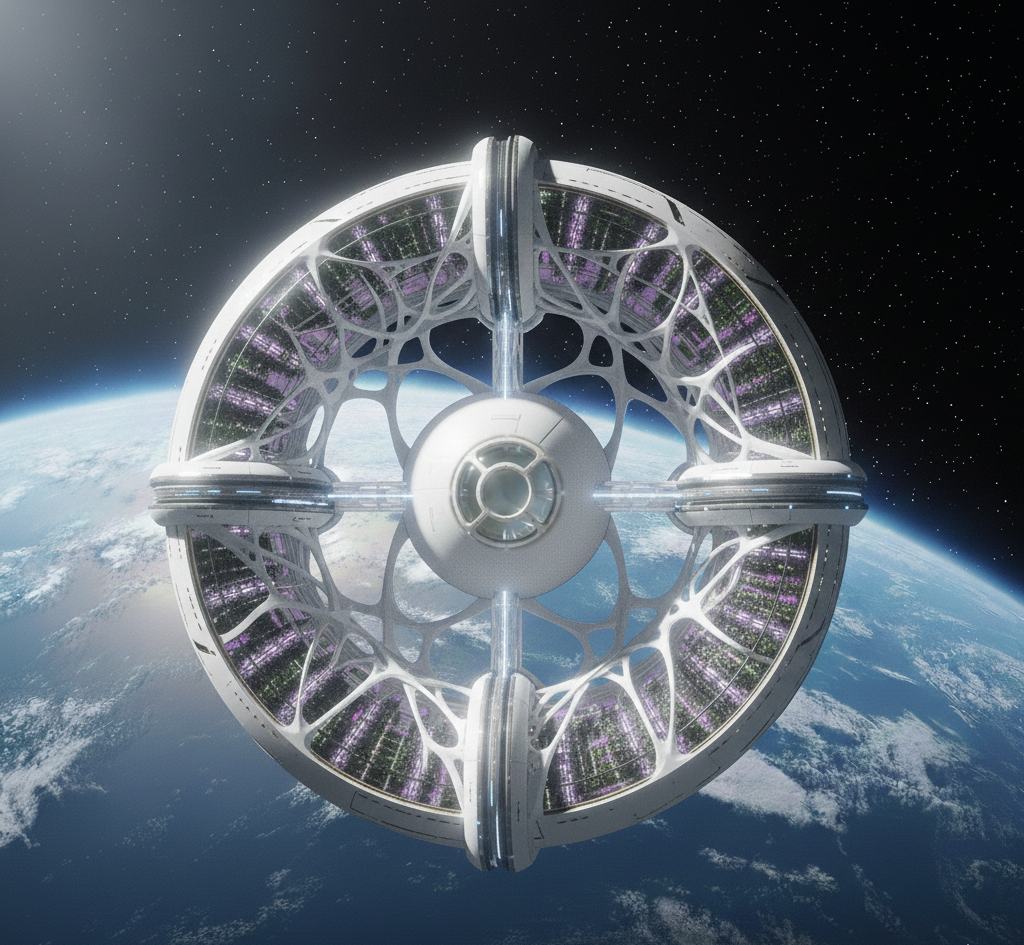
To demonstrate the effectiveness of this methodology, we designed The Cathedral of Life — a 600-meter biomimetic rotating ring station created entirely through pattern-driven AI collaboration.
The core concept is a grand assembly space at the center of the station: the cathedral. A space intended for global government gatherings focused on improving life for humanity — with a choreographed Overview Effect to guide decision-making. Delegates would look up and see Earth through the viewport above them as they deliberate the future of the species.
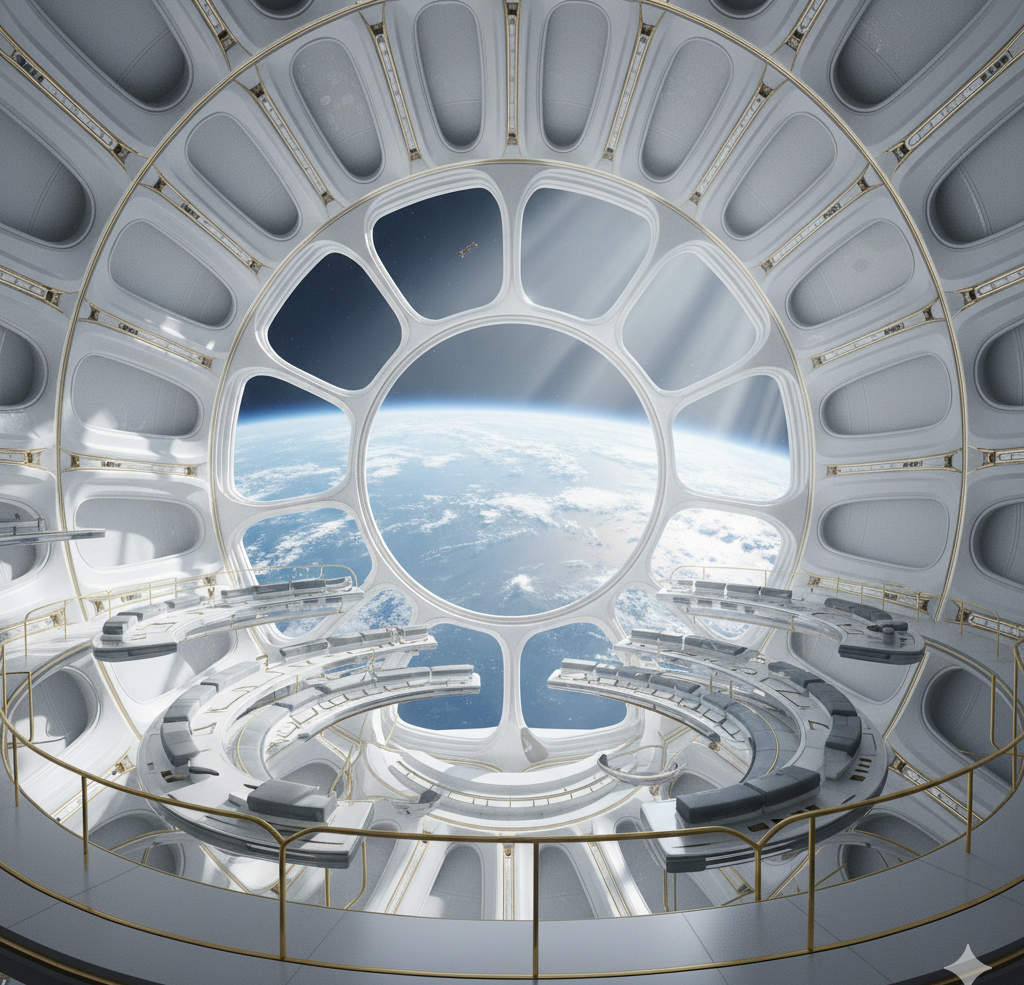
The cathedral interior — Earth visible through the biomimetic viewport, the Overview Effect architecturally choreographed
The station is not a sketch or a mood board. It is a technically grounded design with specific engineering parameters derived from the pattern language:
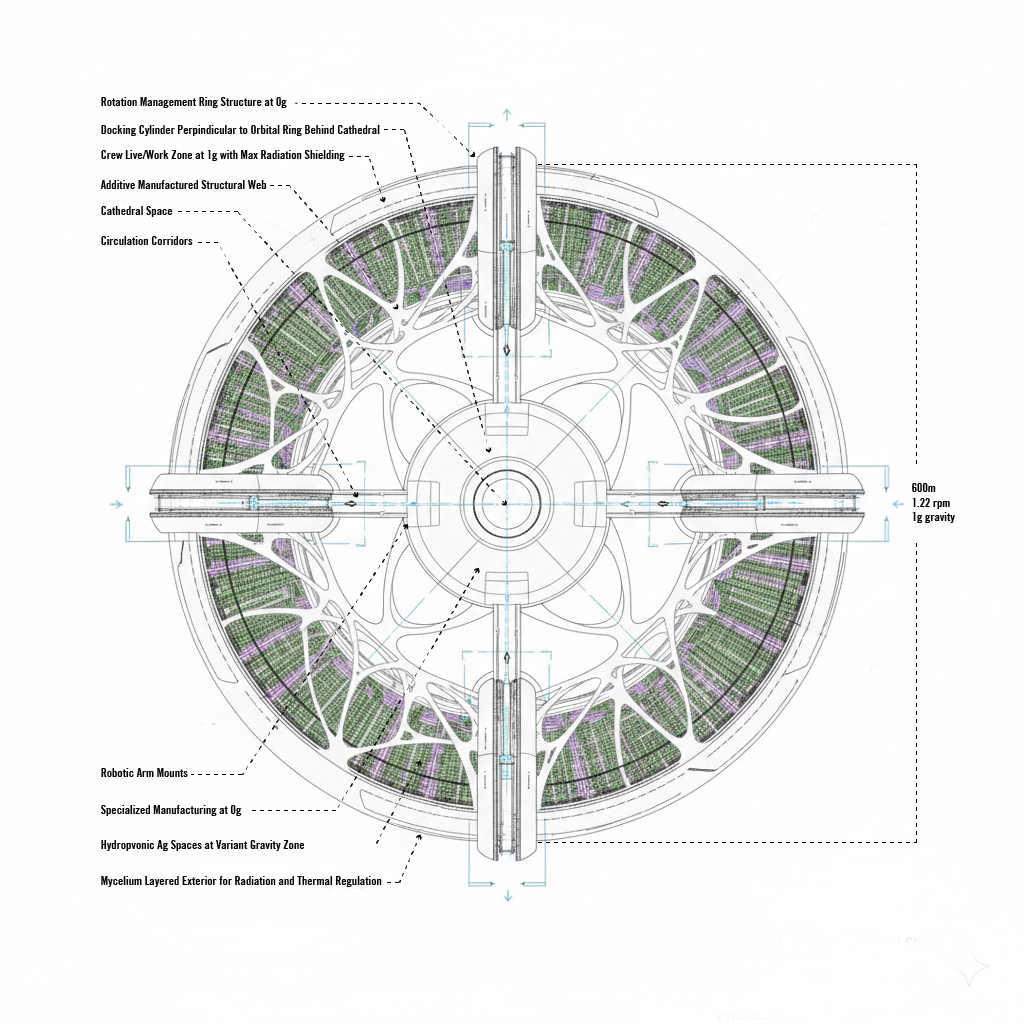
Annotated plan view — structural systems, gravity zones, and functional areas mapped across the 600m ring
Every one of these design decisions traces back through the pattern language to research evidence. The agricultural zones at variant gravity exist because the knowledge snippets from NASA research indicated which crops perform differently under partial gravity. The mycelium exterior exists because patterns synthesized from materials science research identified biological shielding as superior to purely mechanical solutions for long-duration habitats. Nothing is arbitrary.
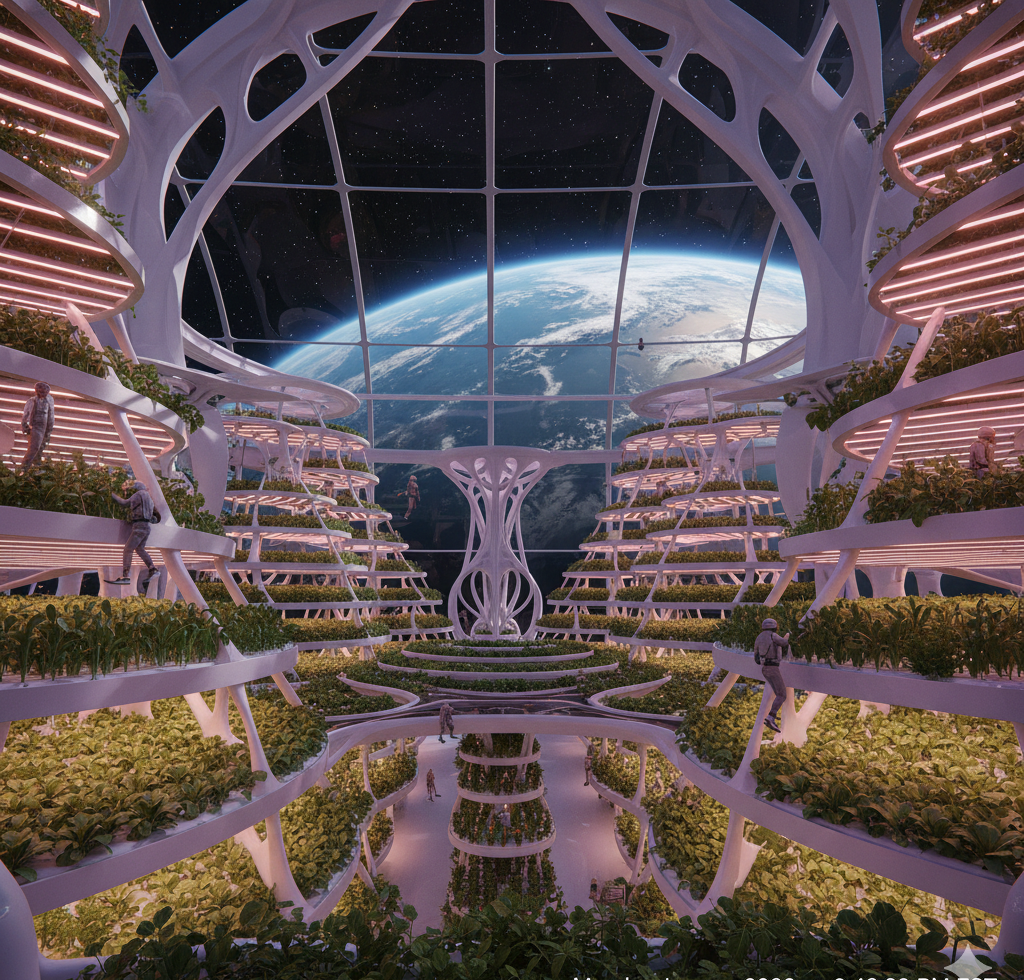
Agricultural biodome — cultivation over extraction, the second pillar made architecture
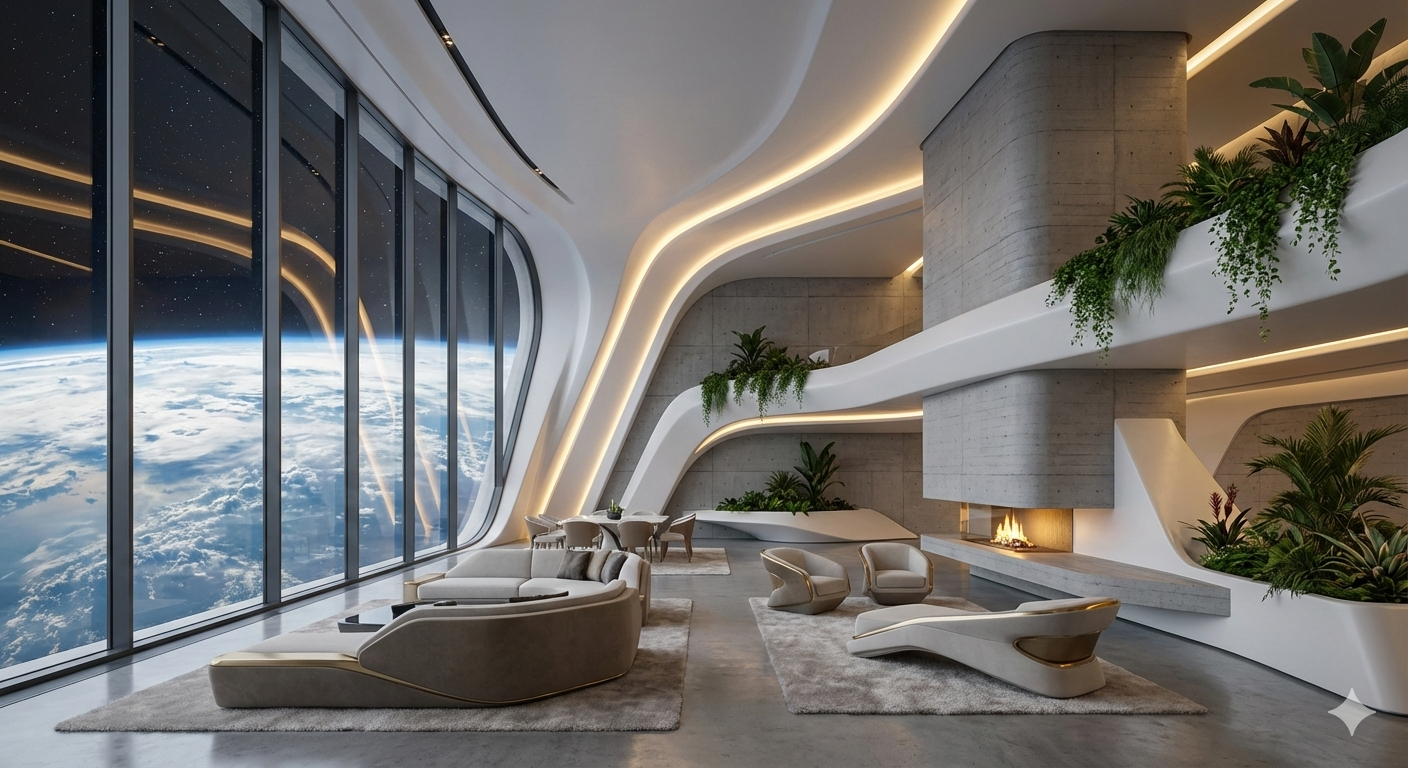
Living quarters — designed for flourishing, not survival. Biophilic materials, Earth-facing viewports, spatial generosity
The Iterative Proof
The Cathedral of Life demonstrates the system’s conceptual range. But the more important proof is in the iterative design process itself — watching the agents reason through patterns, respond to human critique, and build upon each other’s work.
We ran a structured test: a 4-crew lunar habitat for a 90-day mission, designed through sequential agent iterations.
Iteration 1 — Initial Massing
Prompt: “Create basic cylindrical habitat optimized for psychological wellbeing, 4 crew, 90 days”
The Massing agent referenced three knowledge snippets — habitat volume allocation (32 m³/crew baseline), three-tier spatial hierarchy, and microgravity circulation principles — and generated a 200 m³ habitat with a main cylinder, quiet zone, four crew quarters, and central circulation shaft. 50 m³ per crew member.
Result: Geometry generated and executed successfully in Rhino 3D.
Iteration 2 — Human Critique + Refinement
Prompt: “The crew quarters feel too isolated from the main habitat. Adjust the layout so quarters have better visual connection to common areas while maintaining acoustic privacy. Also increase the transition zone — it feels too small for a 90-day mission.”
The Massing agent responded to the critique while maintaining all pattern constraints: expanded to 245 m³, replaced isolated cylinders with integrated alcoves, added visual connection panels for controllable privacy, tripled the medium-intensity transition zone from minimal to 95 m³.
Result: Design improved measurably. Human intent preserved. Pattern constraints maintained.
This is the proof that matters. The agent did not simply regenerate from scratch. It understood the existing design state, interpreted the human critique against its pattern knowledge, and made targeted improvements that addressed the specific concerns while respecting the technical constraints established in the first iteration. The conversation accumulated. The design evolved.
The Technology Stack
Nova Architecture is built entirely on the same technology platform BioSync Labs uses across all client implementations:
The same n8n orchestration, Claude API intelligence, and Airtable knowledge management that powers Nova Architecture is used in our client implementations across agriculture, finance, and business operations. The domain changes. The architecture does not.
Why This Matters
Nova Architecture is not primarily a space architecture project. It is a proof of concept for a methodology.
The methodology is this: take a domain with deep technical complexity. Encode the expert knowledge into a pattern language — reusable, interconnected, simultaneously poetic and precise. Deploy specialist AI agents that can reason about those patterns and apply them to specific design problems. Orchestrate the agents through workflows that preserve context, accumulate state, and enable iterative human-AI collaboration.
The same approach applies wherever expert knowledge needs to be systematized and made accessible through AI:
The space architecture domain was chosen deliberately. If the methodology can handle the complexity of designing a habitat where every system is life-critical and interdependent — it can handle anything.
Nova Architecture was submitted to the MIT Media Lab competition as a demonstration of AI-human collaborative design. The complete system — pattern language, agent architecture, orchestration workflows, and generated output — is documented in the open-source repository.
BioSync Labs designs, builds, and deploys. The same team, the same tools, the same methodology — applied to whatever domain your business operates in. The pattern language is the framework. The agents are the intelligence. The human is always in the chair.
Have a complex domain that needs AI?
Every system we build starts with a 30-minute conversation.
Book a Strategy Session →Theoretical Foundation: Christopher Alexander, A Pattern Language (1977)
Research Sources: NASA Deep Space Habitability Design Guidelines, Human-Centered Design for Space Habitability, Physiological Impacts of Microgravity, and additional technical papers
Repository: github.com/BiosyncLabs/nova-arch
Competition: Submitted to the MIT Media Lab, 2026